Showing posts with label history. Show all posts

Sunday, April 28, 2013

thinking and not


 From my 5th floor studio window I watch the freight trains. There is something anachronistic about them in this age of Fed Ex and the Internet. Mythical, romantic even, like I'm in another century. These could be logs from 1913, traveling from Maine to a shipyard in Brooklyn or Baltimore.


They reminded me of this old photo I have of a ship being built.
(Click on pictures for a better look.)

Oxen!
(Oxes?) (Ox's?) Ox, plural.


Georgia O'Keeffe painted objects so that the viewer would see them in a new way.


I keep trying to capture things in words and paint. Not actually the thing, but its essence.

Painting is totally absorbing. I like that I don't have to think.

Also:

Friday, March 23, 2012

missions

        My father and Brazilian Air Force plane, 1950's

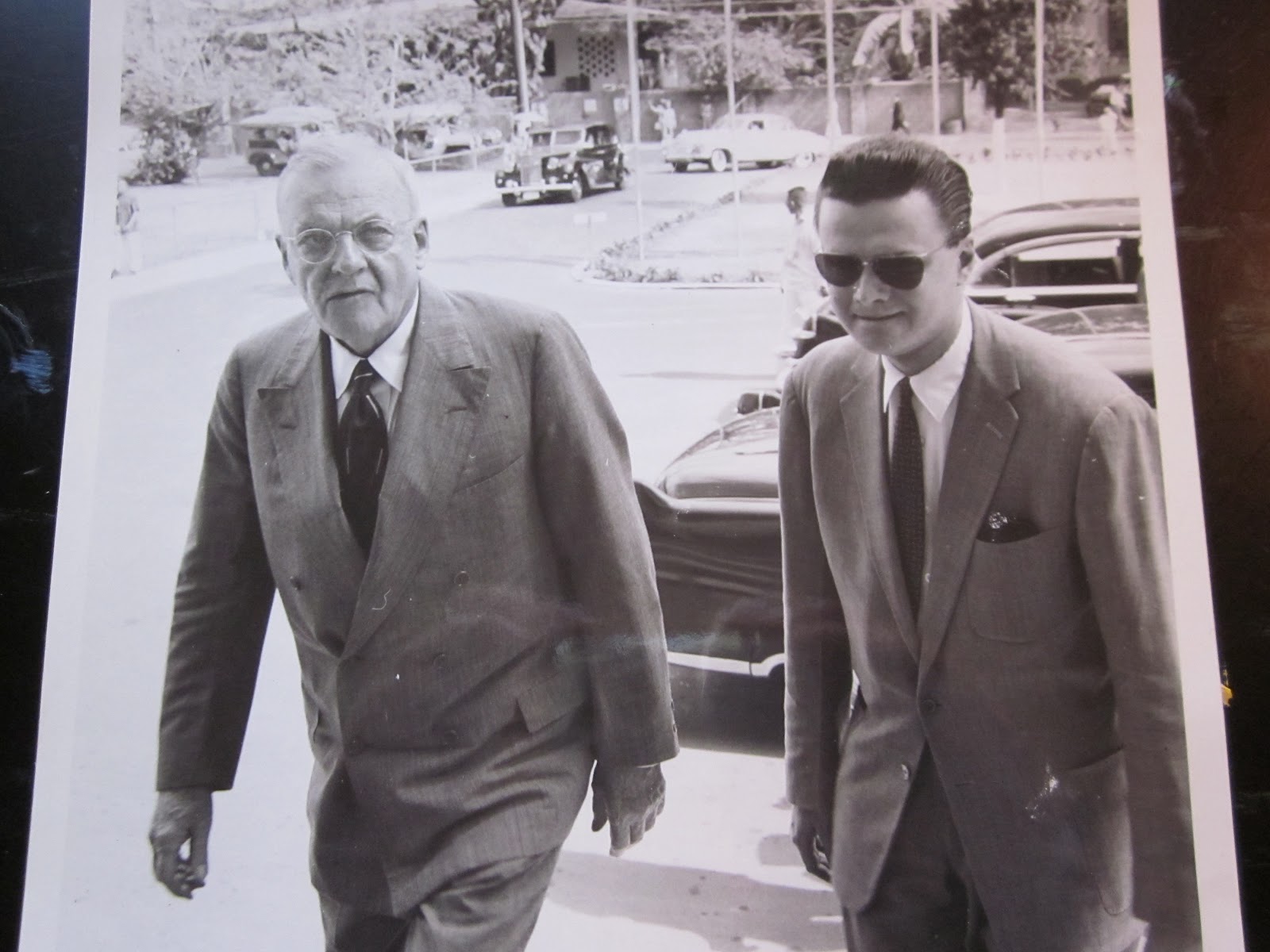
In the 1950's my father worked for the State Department. He travelled the world, had adventures, and brought home interesting things. Many years later, living in San Francisco, he retired for medical reasons. He continued to consult with the Environmental Protection Agency, his employer since 1970, and occasionally manned his friend's high-end antique store, while the friend, a CIA operative, went on missions. (True story.) He and my stepmother also had an antique business, and he was a master of high-low--mixing expensive items with those found at flea markets and garage sales. I have fond memories of accompanying him to the Alameda, Marin, and San Jose flea markets.

My father (sunglasses) and Secretary of State Dulles

In the early 80's they moved to a little house in Yountville California--it was packed with collections. He died in 2006, and after my stepmother died in 2010 (an event that led almost directly to me opening the store--see here) I had to choose what I wanted from their house. I took some special things for my children. For myself the things I wanted were mostly on the flea market end of things--including a large collection of wood-slice paintings he'd picked up here and there. I have about thirty landscapes--lakes, mountains, and so forth, in our Catskills house. I put a few for sale in the store.

Three wood slice paintings of the Cliff House in San Francisco, a place that was special to my father.


 This one, of Mission San Luis Obispo, California, I put in the Etsy store, thinking it might appeal to someone who lives there or collects items relating to missions.


Today, I got this message: "I live in San Luis Obispo and I have recently been put in charge of my elementary school's silent auction fundraiser and was hoping you might be interested in donating this piece. I just had to ask because I really love the idea of bringing this painting "home" and think it would be a huge hit in our auction. We are a terrific little elementary school..." 


I wrote back that I would be happy to donate it. My father would have enjoyed the travels of this little work of art created in San Luis Obispo in 1946 that wound up in Yountville California in the 1980's, Massachusetts in 2011 and is now going back to San Luis Obispo on a mission to raise money for an elementary school.

Jen

Wednesday, September 21, 2011

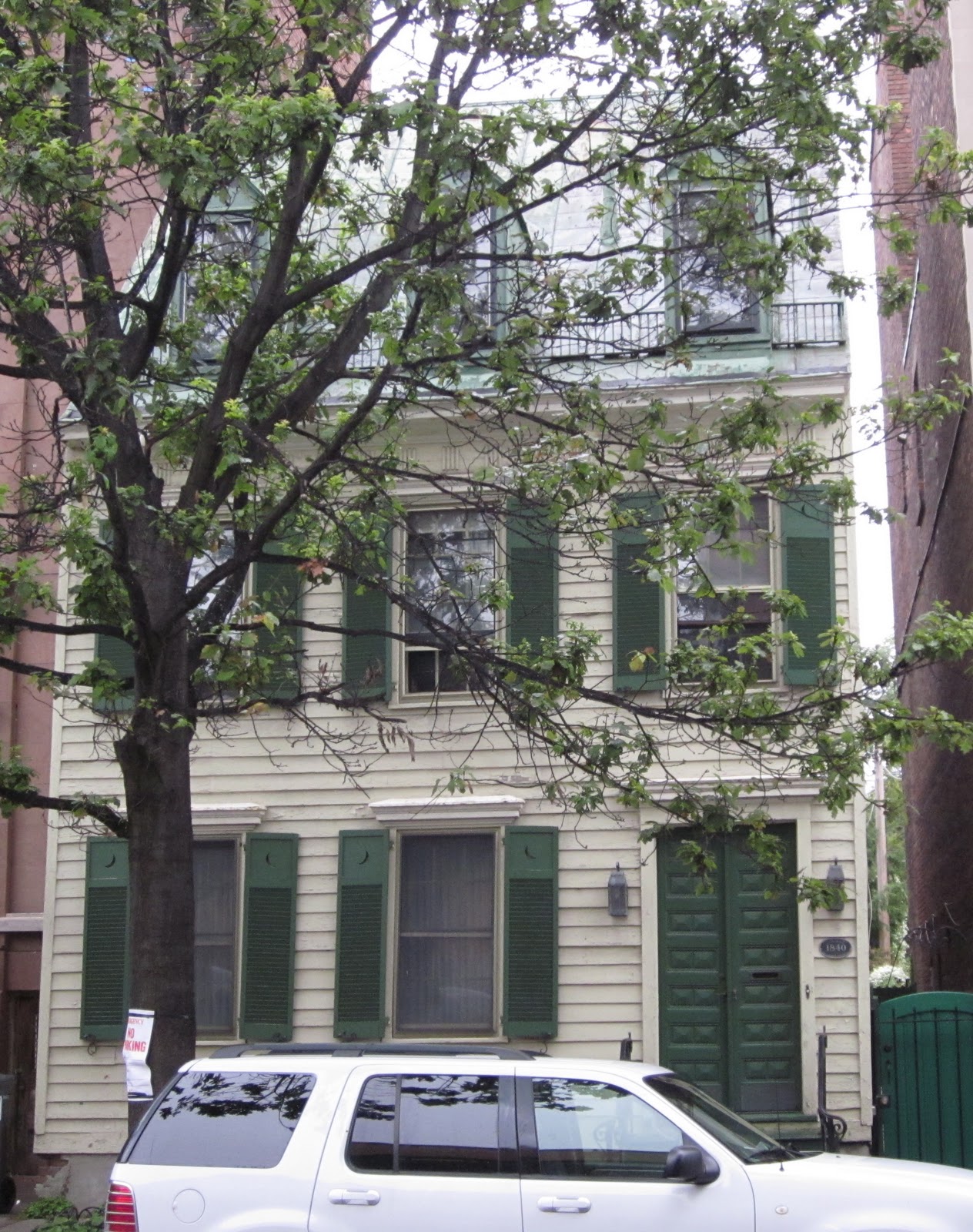
yellow house, green shutters, morning glories

My oldest son recently moved to Albany, the capital of New York state. 
His apartment is in an 1860's row house. It has 14-foot ceilings and a roof garden. In his living room is a walk-in vault, now converted to a closet, but with the heavy old vault door still on it. The original owners must have had some treasures, or perhaps didn't believe in banks.


There are many wonderful old houses from that era in Albany.


 Most are built from brick and stone.


I especially love the old wooden ones. There aren't many left. They are from the 1840's or earlier--after that they stopped building them, because the risk of fire was too great.


This one is my favorite. I love the creamy yellow wood shingles with the green shutters.


The roof is copper.


These morning glories cover a chain link fence that surrounds a parking lot.
Don't the words morning and glory look beautiful together?
And don't those flowers deserve such a gorgeous name?


What do you suppose an edible art gallery is? 

Thursday, September 15, 2011

refreshments, ping-pong, billiards, hostesses


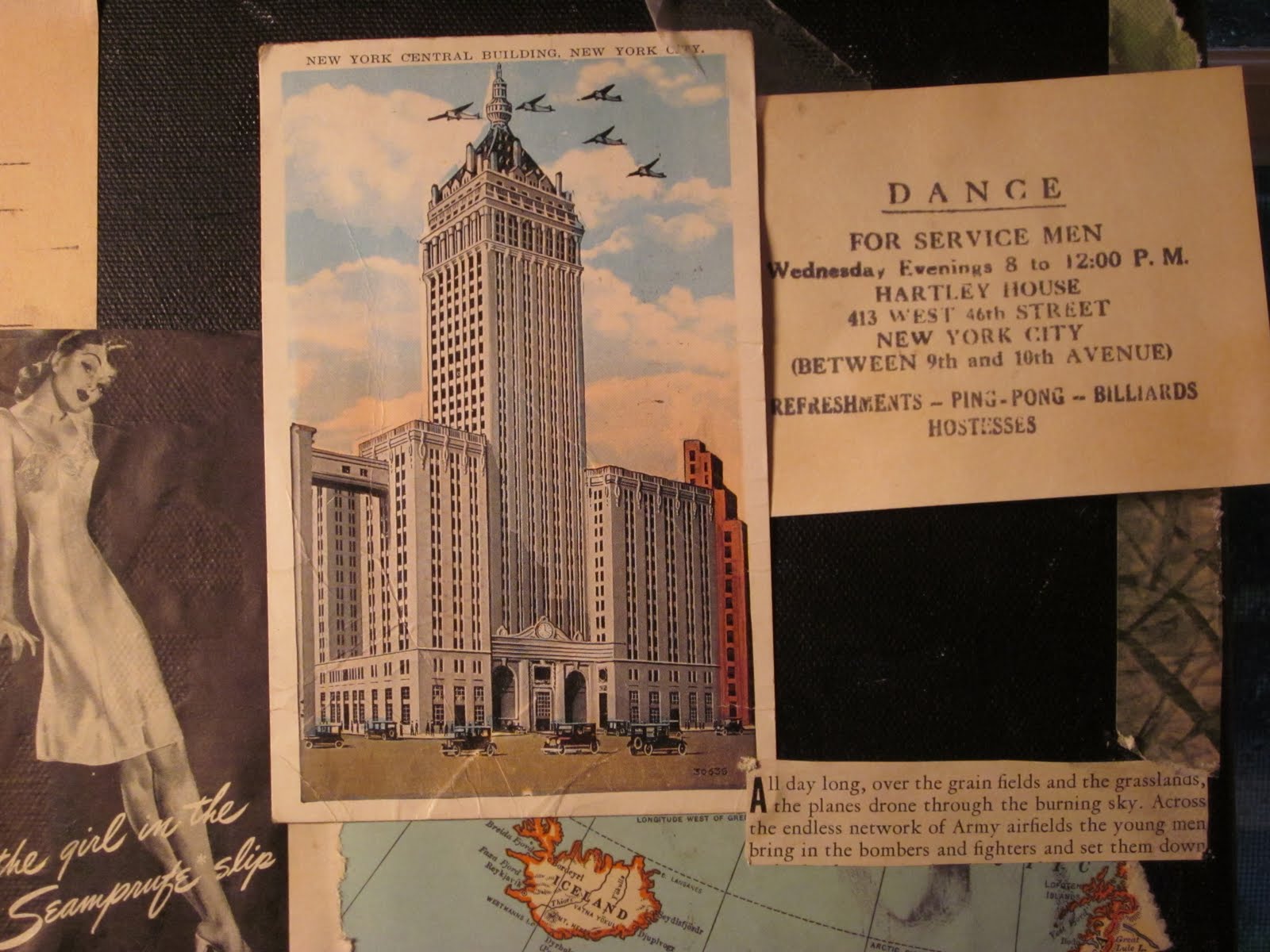
I made a collage using ephemera from the World War II era. Painted a canvas with blended blue and black paint, scuffed it up a bit. (Click on pictures to enlarge.)


I have a suitcase full of letters, pictures and all kinds of memorabilia from the family of Arthur Salve, from the 1940's and 50's. I built the piece around an Enlisted Man's Temporary Pass to visit NY City, made out to Arthur.


From that collection I included a letter written by Arthur's mother about the family farm stand, a typed recipe for peach butter, and a family photo (that may be the Salve's).


I added a map of Europe from an old encyclopedia, a NY City postcard, a ticket to a dance for service men, a lingerie ad and a clipping from a 1943 issue of Life Magazine. I didn't shellac the paper--I wanted it to have a rough feel, like a bulletin board. I have a lot of ephemera from this era and couldn't figure out what to do with it. I like the idea of creating vignettes with these bits of history, and am considering doing a series of them.

I'm heading to the Catskills tomorrow... Enjoy your weekend!

Jen

Friday, July 8, 2011

Reef of Norman's Woe, part 2


I'm not happy with one of the mixed media pieces I showed you here--the one with the postcard Reef of Norman's Woe, Gloucester, Massachusetts. As I looked through papers, postcards, and tattered books for inspiration I came upon a 1931 world atlas. A map, I thought, might be what's needed. I then remembered some old nautical maps that I got at an auction last year, in the garage. I pulled them out--there were four rolled up in a barrel--and one is Ipswich Bay to Gloucester Harbor.


 It was published by the U.S Coast and Geodetic Survey in Washington D.C. in 1920.

Next to the words "Lights, Beacons, Buoys and Dangers Corrected
For Information Received to Date of Issue." 
it is stamped June 26, 1923.

I looked for Norman's Woe.
There it is.
It was time to do some research. 

In January 1839, a great blizzard struck the northeast, destroying many ships, including the schooner Favorite out of Maine, bound for England. Twenty bodies washed ashore including a woman lashed to a piece of the ship. This was not the first shipwreck on Norman's Woe. In 1823 all crew members of the Rebecca Ann were lost. However it is the wreck of the Favorite that inspired Henry Wadsworth Longfellow to write The Wreck of the Hesperus. The last verse:

Such was the wreck of the Hesperus,
In the midnight and the snow!
Christ save us all from a death like this,
On the reef of the Norman's Woe!


This map, and the others, feel loaded with history and I cannot bear the idea of cutting it up. Therefore, my search for ephemera for Norman's Woe continues, and I hope to find a way to incorporate the history of this bit of reef into my little project.

Friday, July 1, 2011

due diligence


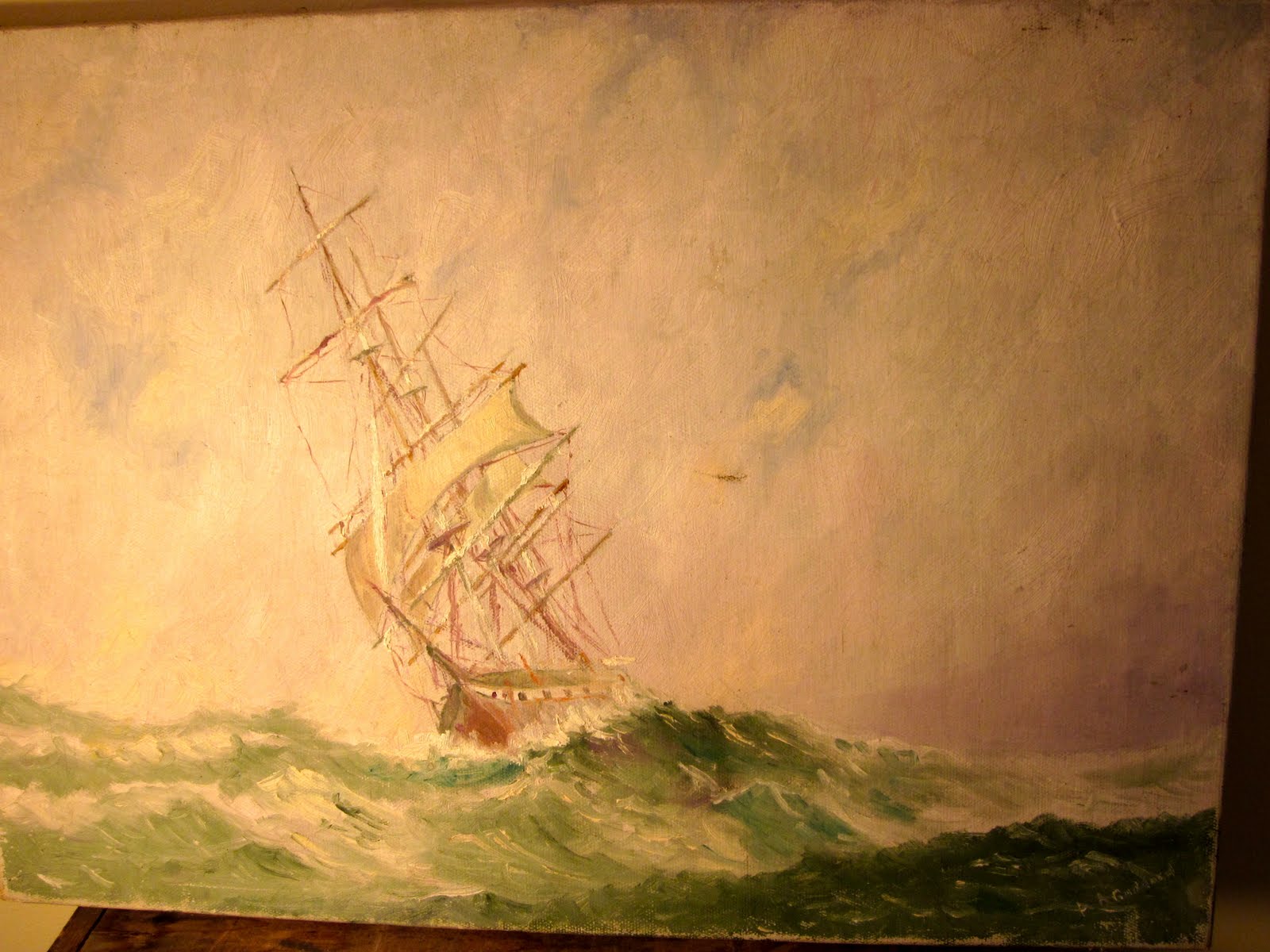
As I've mentioned before, setting a value on antiques is problematic. Example: I got the above oil painting at auction for $10. I didn't love it, but people like ship paintings. It's been hanging around, unloved, so I decided to put in in the Etsy shop. It is signed, not dated, and there was a paper stuck in the back, so I did my due diligence.

 I learned the due diligence lesson the hard way with a different painting-- wondering why a mediocre watercolor got snatched up 5 minutes after I listed it. Can you believe I didn't look up the artist? It wasn't a huge mistake, but big enough not to repeat. (Meaning--if I'd look up the artist I could have sold it for a few hundred dollars instead of a lot less than that.) So A A Goddard who painted this little clipper ship scene approximately 200 years ago was googled by me.


In addition to the signature, A A Goddard, I had another clue: the paper stuck in back of the canvas was a copy of a page from an index. The top of the page notes that the abbreviation PAC refers to the Providence Art Club. Presumably Providence Rhode Island, since the auction was in Massachusetts a few miles from the Rhode Island border. It lists Angell, Abigail, Wife of William Goddard. A few keystrokes showed that Abigail lived from 1758-1845, that William started the first newspaper to be printed in Providence, helped develop the postal system, and has a page on Wikipedia. They had 5 children and their family papers are in the Rhode Island Historical Society. I found nothing referring to Abigail as an artist.

I took another look at the index and saw Arnold, Benedict. The words "not that Benedict Arnold" popped into my head--a phrase from childhood. My father's mother's family (her name was Miriam Rhodes) came from Rhode Island. Zachariah Rhodes settled there with Roger Williams in the 1600's. He married Joanna Arnold, sister of Benedict, a governor of Rhode Island. Zachariah and Joanna's daughter Rebecca, married Roger Willams' son Daniel. Maybe one of my ancestors knew Abigail.


So, what is the value of the painting--monetary and/or historical? Should I find out if the Rhode Island Historical Society wants it? Save it in case one of my sons is interested? On its face (without the historic information) I doubt I could sell it for more than $50-75--but I'd be happy with that if the person loved it. What do you think I should do?

And now I'm off to the Catskills for the long Independence Day Weekend which will be especially good since my oldest son and his girlfriend, and my youngest will be there too. Hope you have a great weekend.

Jen

Thursday, May 26, 2011

Bovina earmarks

Bovina is a tiny village in the Catskills, lovely and rural. There used to be many family dairy farms; now very few. I wanted to buy a house there just so I could say I live in Bovina. So much more etymologically interesting than Andes or Margaretville. (There is also a nearby town called Delhi. Pronounced "Del-hi".)


Speaking of etymology, thanks to Bovina Town Historian Ray LaFever, I now know that earmarks aren't just Congressional pet projects--they are identification marks on an animal. Bovina farmers used them to identify their sheep. Mr. LaFever found, in the town records, a book of earmarks dating from 1820 to 1836. Next to each farmer's name is a description of the earmark and some drawings. You can read more on Mr. LaFever's blog, and I must give credit to the Watershed Post where I first read about it. Now, isn't that interesting?

Tuesday, April 12, 2011

toy soldiers

I got these soldiers at the auction last week.
They're hand-carved from clothespins. Their arm and rifle are glued on.

Some are battlefield casualties.

It was a big auction--600 + lots. They were in a box, kind of hidden away. It was getting late, most people were gone, and the auctioneer did requests--we got five minutes to bring up things we wanted put up. Whatever was left would go at the next auction. I brought up the box of soldiers and won them. I photographed them to put in the etsy store and spent some time looking for something similar on the internet. I couldn't find anything and wasn't sure how to price them.


I took a look at the box. The top is broken and I hadn't paid attention to it. I was debating whether to include it in the etsy listing, because it would really increase the shipping cost. I had noticed that Bob's Soldiers was written in pencil. Then I looked closer. (Click on the pictures to enlarge.)

Does that say 1860?

Yes it does. 

Bob's Soldiers
1860
Made by him

1860 was one year before the start of the Civil War. So now what do I do with them? EDIT I would love to donate them to a small New England museum, if I find one that wants them.


Sometimes I wonder why I'm doing this. Then something like these guys come along, and I remember. It's the history and stories and people. Bob making his soldiers 150 + years ago. No internet, tv, radios, planes, cars, electric lights or phones. The transcontinental railroad was not completed. Just him and a knife and some clothespins, somewhere in New England, making toy soldiers.

What do you think I should do with them?

Jen